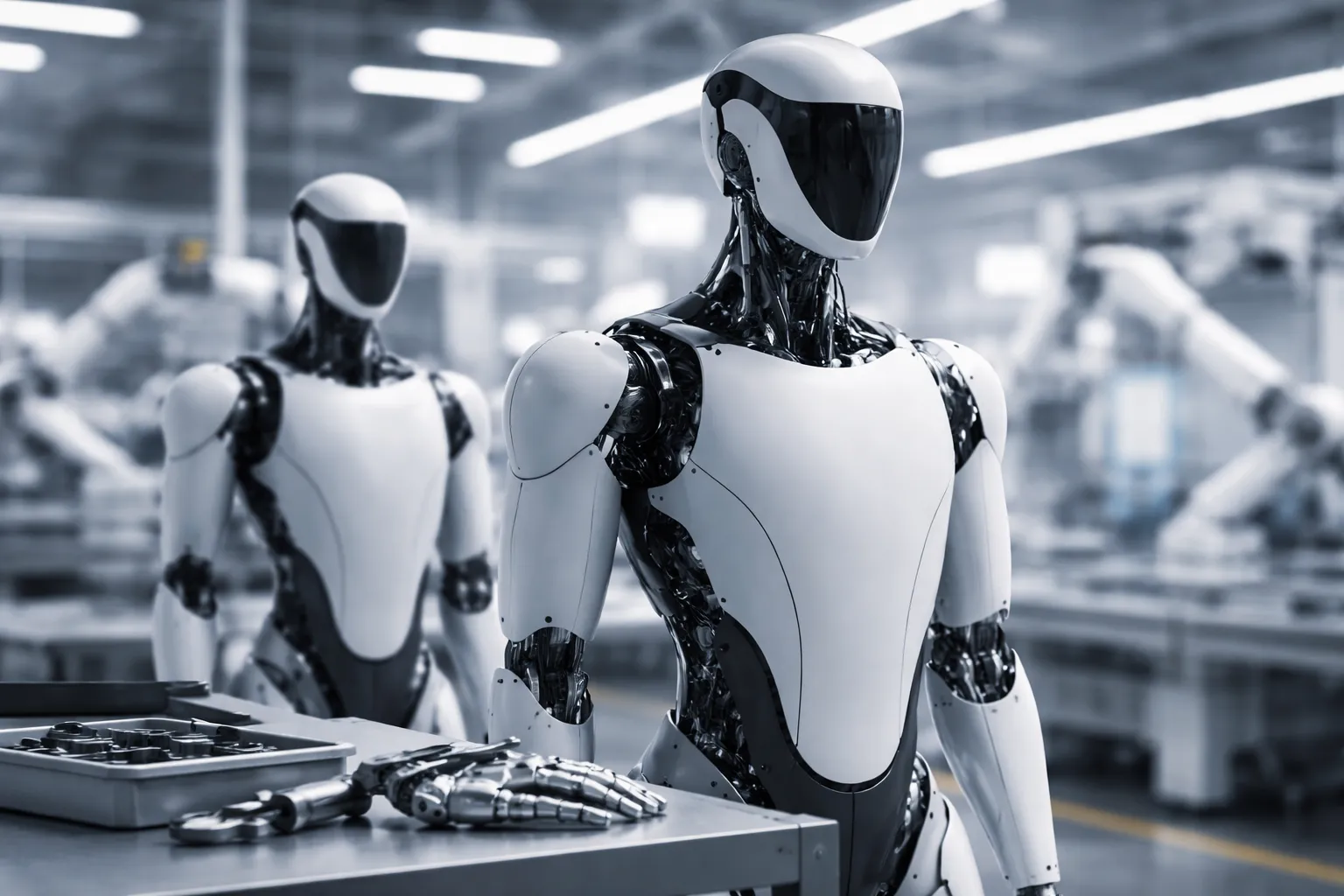
Tesla is considering adding humanoid robot production to its Shanghai Gigafactory, expanding the facility beyond electric vehicles and energy storage into AI robotics manufacturing. The move, reported by TechNode, highlights Tesla’s effort to leverage its most efficient production base to address one of the sector’s core bottlenecks: scaling humanoid robot output.
The development matters because manufacturing scale, not just AI capability, is increasingly the limiting factor in humanoid commercialization. By evaluating Shanghai as a production hub, Tesla is signaling that cost efficiency, supplier density, and operational maturity will determine which players can move from prototypes to deployable systems.
Tesla’s Shanghai plant has been central to its global manufacturing strategy since 2019, producing vehicles at scale and benefiting from deep localization of suppliers. The facility also began producing energy storage systems in 2025, demonstrating its role as a multi-product manufacturing platform.
Manufacturing Scale Becomes the Core Constraint
Tesla executives have already framed production as the primary challenge for humanoid robots. Company leadership in China described the Shanghai operation as a potential “golden key” to solving mass manufacturing constraints, though specific timelines or production targets have not been disclosed.
This aligns with broader industry dynamics. While Tesla’s Optimus program has demonstrated early-stage industrial tasks, overall shipment volumes remain limited, with fewer than 500 general-purpose robots shipped in 2025 according to external estimates.
For enterprise buyers, this gap between demonstration and deployable scale remains the central barrier to adoption. A Shanghai-based production strategy could materially change unit economics if Tesla can replicate its EV manufacturing efficiencies in humanoid systems.
China’s Supply Chain Advantage
Locating humanoid production in Shanghai would place Tesla directly inside the world’s most mature robotics and electronics supply chain. The region offers dense networks of component suppliers, lower manufacturing costs, and strong policy support for automation and AI industries.
This is particularly relevant as Chinese robotics companies accelerate their own humanoid programs, often targeting industrial use cases such as automotive manufacturing and logistics. Tesla’s presence in the same ecosystem could intensify vendor competition while also benefiting from shared infrastructure and talent pools.
From a commercialization perspective, proximity to suppliers reduces bill-of-material costs and shortens iteration cycles. These factors are critical for humanoid robots, where hardware complexity and reliability requirements remain significantly higher than traditional industrial automation systems.
Implications for Enterprise Deployment
If executed, Shanghai-based production could accelerate Tesla’s ability to supply humanoid robots for internal use cases first, particularly in manufacturing environments. Tesla has already indicated that Optimus is being trained on factory workflows, suggesting an initial deployment model focused on internal automation before external sales.
This approach mirrors historical industrial robotics adoption, where companies first validate systems within their own operations to refine reliability and ROI metrics. It also allows Tesla to benchmark labor substitution economics directly within its production lines.
However, key unknowns remain. Tesla has not confirmed timelines, production volumes, or whether Shanghai would serve domestic Chinese demand, global exports, or both. Regulatory considerations, particularly around advanced robotics and AI deployment in China, could also shape execution.
Strategic Positioning
The potential expansion reinforces Tesla’s positioning as both an AI and manufacturing company rather than a pure automotive OEM. It also reflects a broader capital allocation shift toward robotics and automation, areas CEO Elon Musk has repeatedly emphasized as long-term growth drivers.
For the humanoid robotics sector, the signal is clear. Companies that can industrialize production, not just improve dexterity or autonomy, are more likely to secure enterprise contracts. Tesla’s Shanghai strategy, if realized, would directly test whether EV-style manufacturing scale can translate to humanoid systems.
The next phase will depend on execution clarity. Enterprise buyers will look for concrete indicators such as pilot deployments, unit pricing, reliability benchmarks, and production throughput before committing to large-scale adoption.