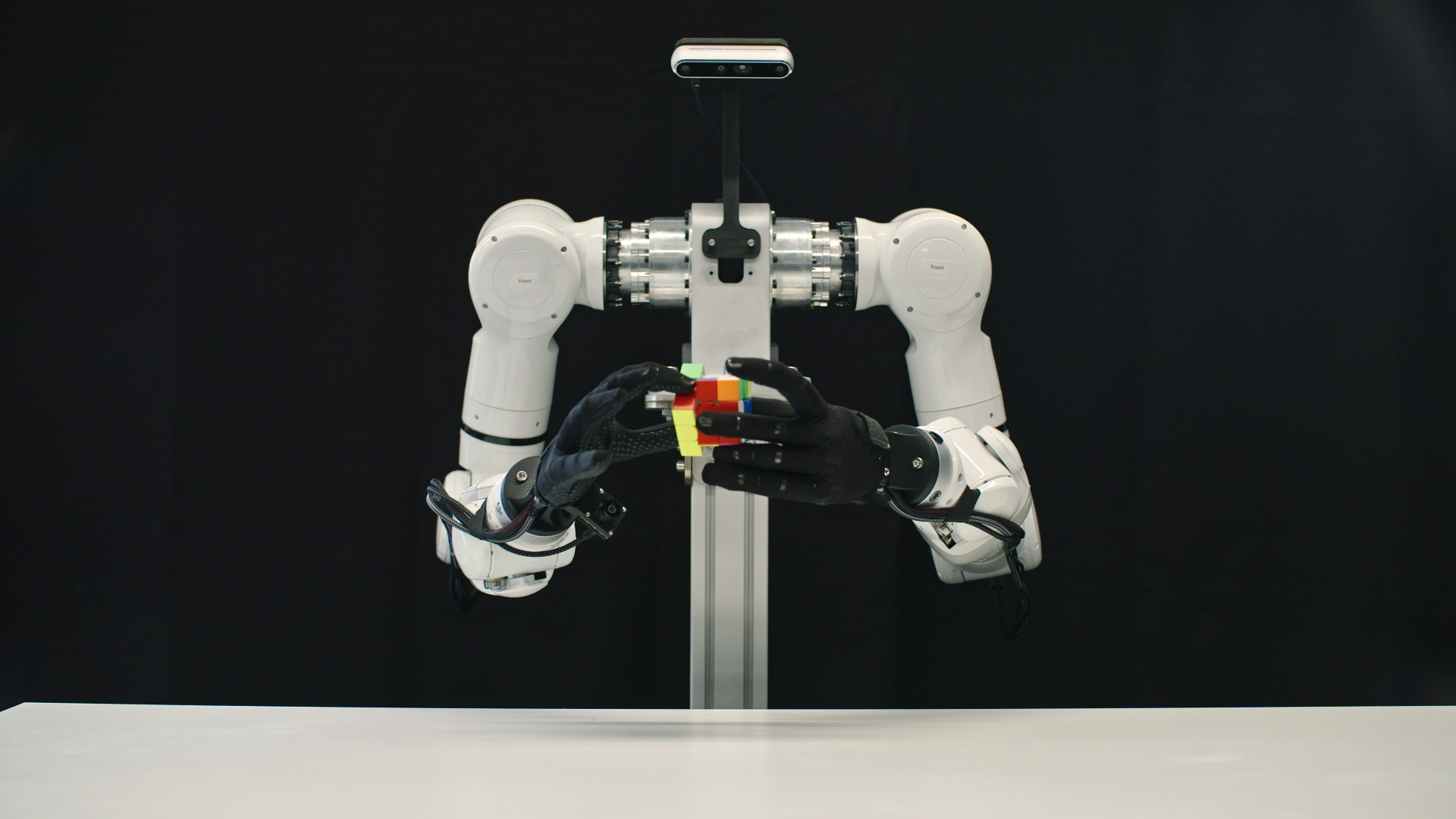
Genesis AI, a French robotics startup founded in 2025, unveiled a new robotics foundation model called GENE-26.5 alongside a highly dexterous humanoid robotic hand designed for industrial tasks. The announcement signals a broader shift in humanoid robotics commercialization toward vertically integrated platforms that combine physical manipulation hardware with AI-driven autonomy for enterprise automation.
The company said the system is being developed for precision-intensive industries including automotive manufacturing, electronics assembly, pharmaceuticals, and logistics. Genesis AI is reportedly in advanced discussions with industrial customers in France, Germany, and Italy, although deployment partners have not yet been publicly disclosed.
The development is notable because dexterous manipulation remains one of the primary bottlenecks preventing large-scale humanoid deployment in commercial environments. While mobility has improved rapidly across the sector, enterprise operators continue to evaluate whether humanoid systems can reliably perform repetitive, high-precision workflows at acceptable uptime and cost.
Genesis AI’s robotic hand attempts to address that gap through a biologically inspired architecture that mirrors human hand structure and movement. Demonstrations released by the company showed the system performing fine motor tasks including cracking eggs, chopping vegetables, solving a Rubik’s Cube, and playing piano. While such demonstrations are not equivalent to industrial validation, they highlight progress in force control, manipulation fidelity, and embodied AI coordination.
The company also revealed it is collecting industrial motion datasets using sensor-equipped gloves worn by workers. That strategy reflects a growing industry consensus that humanoid robotics deployment will depend heavily on access to proprietary real-world behavioral data, particularly for manipulation training.
Industrial Robotics Suppliers Expand Humanoid Exposure
Genesis AI enters a humanoid robotics market that is increasingly attracting established industrial suppliers and manufacturing companies seeking exposure to next-generation automation infrastructure.
German motion technology supplier Schaeffler said this week it expects humanoid robotics orders to reach several hundred million euros by 2030. The company disclosed collaborations with roughly 45 robotics firms globally and confirmed five active humanoid customer contracts, primarily tied to Chinese and U.S. companies.
At the same time, Chinese dexterous robotics company Linkerbot announced plans to pursue a $6 billion valuation following rapid growth in robotic hand manufacturing. The company claims more than 80% market share in high-degree-of-freedom robotic hands and plans to double production capacity from roughly 5,000 units monthly to 10,000.
The emergence of specialized hand and actuator suppliers suggests the humanoid robotics supply chain is beginning to mature beyond prototype development. Investors and enterprise buyers are increasingly evaluating not only full humanoid platforms, but also critical subsystem providers capable of enabling scalable deployment economics.
For Europe specifically, Genesis AI’s launch also reflects regional efforts to strengthen sovereign robotics capability amid growing dependence on U.S. AI infrastructure and Chinese hardware manufacturing. The company has raised approximately $105 million in seed funding, one of the largest seed rounds in the French robotics sector to date.
The next commercial milestone will likely depend on whether Genesis AI can transition from controlled demonstrations to repeatable industrial workflows with measurable return on investment. Enterprise customers continue to prioritize reliability, safety integration, maintenance costs, and workforce compatibility over generalized humanoid capability claims.
As humanoid robotics moves closer to pilot deployment at manufacturing scale, companies controlling dexterous manipulation technology may become critical infrastructure providers across the broader AI robotics ecosystem.