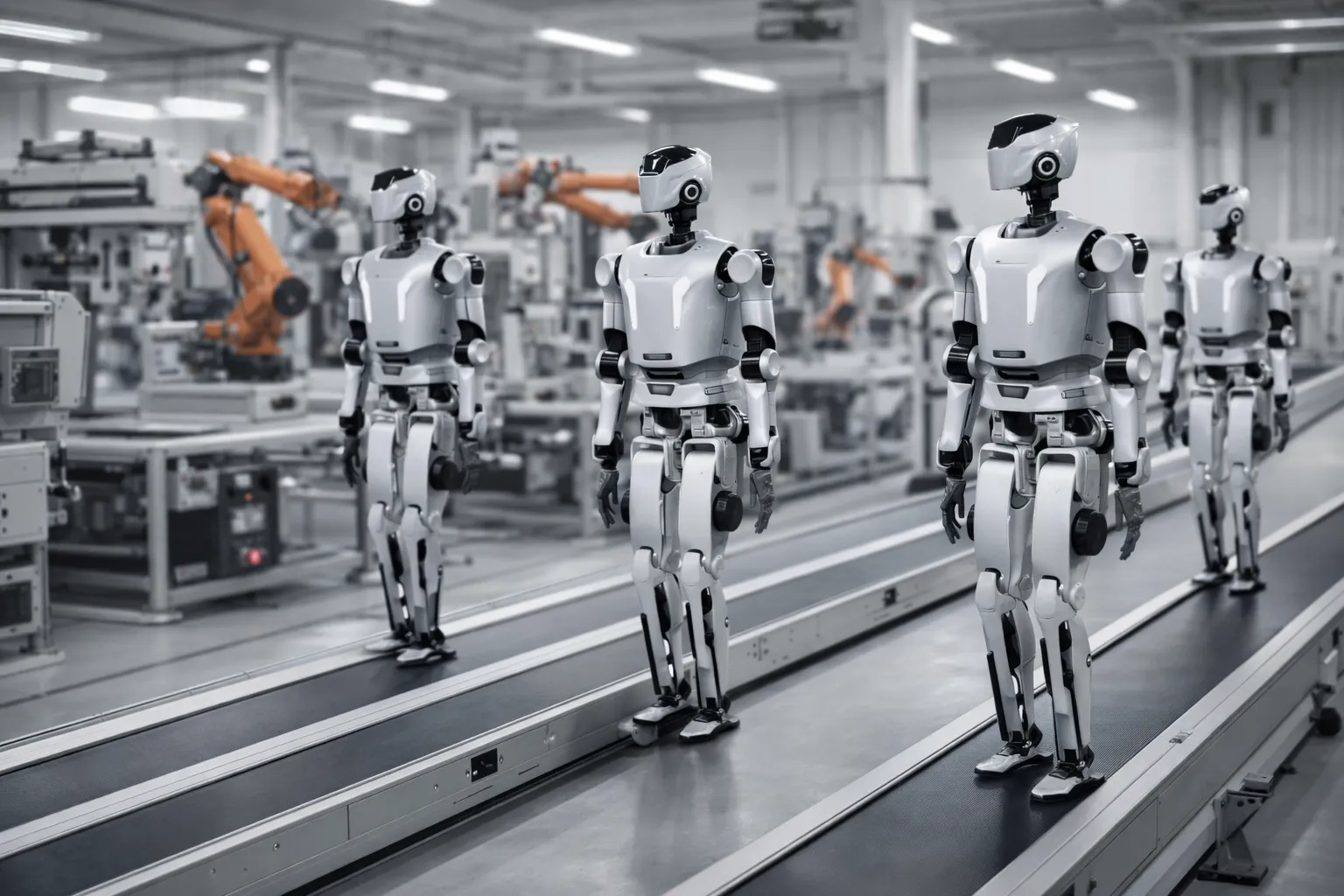
China has launched an automated production line for humanoid robots in Guangdong with a stated annual capacity exceeding 10,000 units, according to Xinhua. The development signals a transition from prototype-stage systems toward industrial-scale manufacturing, a necessary step for broader enterprise deployment. However, key details around customers, pricing, and real-world use cases remain undisclosed.
The production line is designed to output roughly one humanoid robot every 30 minutes. While the article does not specify the operating company or robot models involved, the scale alone places it well beyond the current production levels of most humanoid robotics firms, many of which remain in pilot or low-volume manufacturing phases.
The announcement reflects a growing emphasis on manufacturing readiness as a bottleneck in humanoid robotics commercialization. Moving from lab-scale builds to repeatable, high-throughput assembly requires standardized components, stable supplier relationships, and defined production workflows. These factors often determine whether humanoid systems can reach cost points suitable for enterprise adoption.
Manufacturing Scale Signals Strategic Positioning
Guangdong’s role as a global electronics and robotics manufacturing hub provides structural advantages. The region offers established supply chains for actuators, batteries, sensors, and embedded systems, all of which are critical components in humanoid robots. Leveraging this infrastructure could reduce production costs over time, particularly if volumes approach the facility’s stated capacity.
For enterprise buyers, manufacturing scale is directly tied to procurement confidence. Large-scale production capacity can signal vendor reliability, shorter lead times, and the potential for ongoing support and spare parts availability. However, without confirmed deployment contracts or disclosed customers, it remains unclear whether demand currently justifies the announced capacity.
The 10,000-unit figure should be interpreted cautiously. Capacity does not equate to actual production output or shipments. Across the humanoid robotics sector, most companies are still validating use cases in logistics, manufacturing support, and service environments. Few have demonstrated sustained, large-scale deployments with clear return on investment.
From a commercialization perspective, the more significant question is whether production throughput will translate into viable unit economics. High-volume manufacturing can reduce per-unit costs, but only if utilization rates are sufficiently high. Idle capacity or limited demand could offset those gains, particularly in a capital-intensive category like humanoid robotics.
The announcement also highlights intensifying global competition around manufacturing leadership. As companies in the United States, Europe, and Asia push toward commercialization, the ability to scale production efficiently may become a key differentiator alongside software capability and system performance. China’s early investment in production infrastructure could influence pricing dynamics and supply chain positioning across the sector.
At the same time, the absence of disclosed safety certifications, regulatory alignment, or deployment environments underscores the gap between manufacturing readiness and real-world integration. Enterprise adoption will depend not only on hardware availability, but also on reliability, safety compliance, and integration with existing workflows.
Looking ahead, the next critical signal will be whether this production capacity converts into confirmed deployments. Signed enterprise contracts, repeat orders, and demonstrated operational ROI will ultimately determine whether large-scale humanoid manufacturing is matched by equally scaled demand.