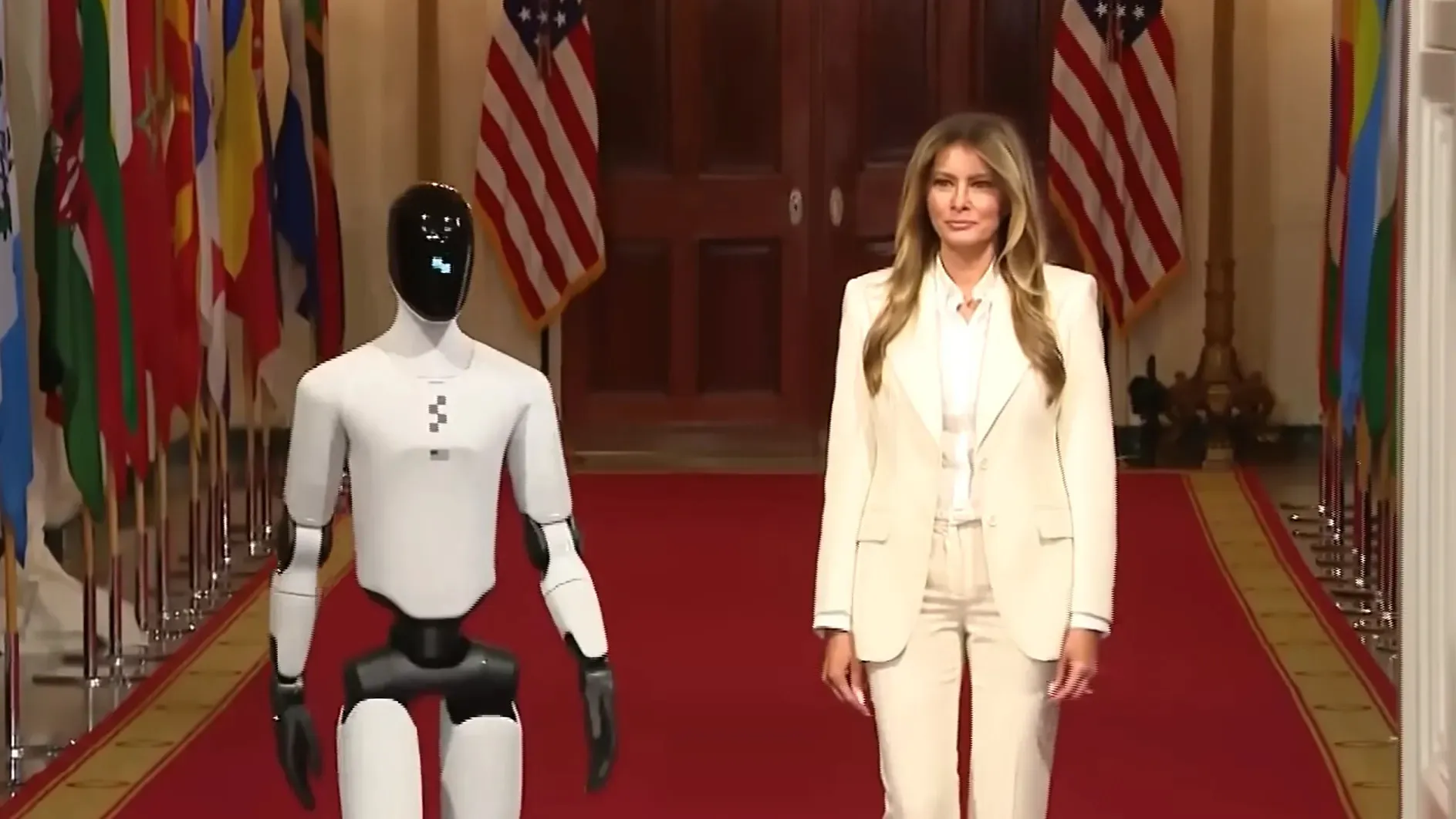
The White House announced the launch of the “Fostering the Future Together” coalition, a 45-member international initiative led by First Lady Melania Trump, focused on advancing children’s welfare through technology, education, and workforce development. While broad in scope, the program explicitly incorporates artificial intelligence and robotics into its vision, signaling growing policy support for AI-mediated learning systems and future humanoid integration.
The coalition brings together governments, private sector participants, and civil society organizations, positioning itself as a coordination layer for digital education strategies. Although the official briefing does not outline specific procurement programs or robotics deployments, the inclusion of automation technologies in a multilateral framework elevates their relevance in national education planning.
This matters for the humanoid robotics sector not because of immediate deployment, but because of policy normalization. When robotics is embedded in international education agendas, it begins to shape funding priorities, regulatory pathways, and long-term procurement assumptions across participating countries.
Early-stage policy framing with downstream commercial impact
The announcement stops short of detailing how robotics will be implemented in classrooms or homes. There are no references to pilot programs, vendor partnerships, or technical standards. However, the structure of the coalition suggests that these elements could emerge through working groups or bilateral initiatives.
For enterprise vendors and investors, the key signal is alignment. Education is one of the largest global labor markets, and even partial automation through AI systems could materially affect cost structures. A coordinated international approach increases the likelihood of shared standards, which could reduce fragmentation and accelerate vendor scalability over time.
Humanoid robotics companies, including those developing general-purpose systems, may benefit indirectly. While current hardware is not suited for unsupervised child interaction, policy frameworks established today will influence certification requirements, safety expectations, and acceptable use cases in the future.
The coalition also reflects a broader shift in how governments approach workforce development. By linking education with emerging technologies, policymakers are implicitly preparing for labor market transitions driven by automation. This creates a feedback loop where education systems are both shaped by and preparing for increased AI and robotics adoption.
Implications for vendor competition and ecosystem positioning
At this stage, the initiative is vendor-neutral. No specific robotics companies or AI platforms are named in the official release. This leaves room for competition among edtech providers, AI platform companies, and humanoid robotics developers to define their roles within future implementations.
For humanoid vendors, the opportunity lies in long-term positioning rather than near-term revenue. Participation in standards discussions, safety frameworks, and pilot programs will likely determine which companies are considered viable partners when governments move from strategy to deployment.
The absence of defined funding mechanisms or timelines suggests that commercialization remains several layers removed. However, the involvement of 45 countries introduces scale as a future variable. If even a subset of participating nations pursue AI-enabled education pilots, the cumulative demand could become meaningful for both software and hardware providers.
Industry trajectory
The launch of the coalition reinforces a pattern seen across humanoid robotics: policy narratives are expanding ahead of technical readiness. Education joins healthcare and domestic assistance as sectors where governments are signaling interest before viable deployment models exist.
For the humanoid robotics ecosystem, the immediate takeaway is not adoption, but legitimacy. Robotics is increasingly being framed as part of national and international infrastructure discussions, which historically precedes funding allocation and regulatory development.
The next phase to monitor is whether the coalition produces concrete outputs, such as pilot programs, safety standards, or procurement guidelines. These will determine whether the initiative remains a strategic dialogue platform or evolves into a driver of real-world humanoid deployment.